
email
+1 (778) 680-3690
address
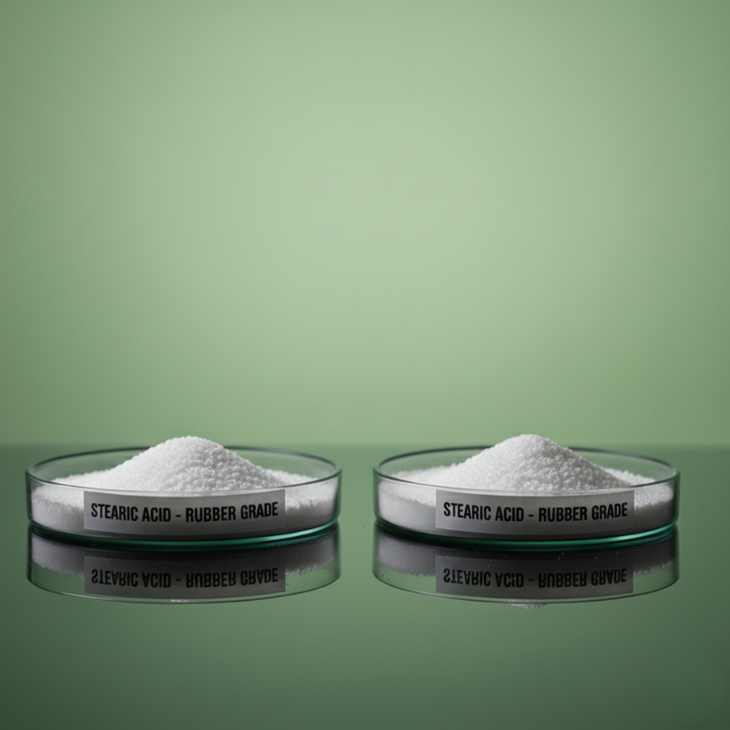
Stearic acid in rubber grade form plays a surprisingly important role in the secret mechanical ballet that turns raw elastomers into strong, flexible rubber. In this context it behaves less like a cosmetic thickener and more like a chemical diplomat, helping different ingredients cooperate during compounding. It acts as an activator in the vulcanization process—this is the heat-driven reaction that transforms soft polymer chains into a cross-linked, durable network. By reacting with zinc oxide, stearic acid forms zinc stearate, a compound that improves dispersion of fillers, accelerators, and other additives throughout the rubber matrix. Better dispersion means more consistent curing, higher mechanical strength, and improved elasticity.
It also works as a mild internal lubricant, reducing friction during mixing and molding. That small reduction in resistance makes the rubber easier to process, lowers energy consumption, and decreases wear on machinery. In filled systems—especially those loaded with carbon black or mineral fillers—stearic acid helps achieve a uniform distribution, which leads to smoother surfaces and predictable material properties.
Because of these combined effects, rubber-grade stearic acid shows up almost everywhere in the rubber world: tires, conveyor belts, hoses, shoe soles, industrial seals, and countless molded components. In each case it quietly ensures that the final product is stronger, more stable, and more reliable. As with many ingredients in polymer chemistry, its magic lies not in a dramatic reaction but in the subtle way it shapes the behavior of all the ingredients around it.